
Deep Linking API
Launch your iOS app via custom URL schemes and deep link users to specific pages of your web app.
The Deep Linking API makes it easy to direct users to specific content inside your app. WebViewGold allows you to configure a Custom URL Scheme (e.g., webviewgold://) that can be triggered from apps like Mail, Safari, and others to open links directly in your WebView app.
Note: the app needs to be installed first for this feature to work.
Alternatively, it is possible to use our Universal Links API. While it operates in a similar manner, it uses a different syntax which is more common than the syntax of the Deep Linking API. For most apps, it's wise to choose either one, but not both.
To set up Deep Linking in your iOS app, please follow the steps below:
- Open Config.swift:
- Set
ShowExternalLinktotrue.
- Set
- Open Info.plist:
- Change the URL Scheme to your own app name (e.g.,
your-app-name://instead ofwebviewgold://).
- Change the URL Scheme to your own app name (e.g.,

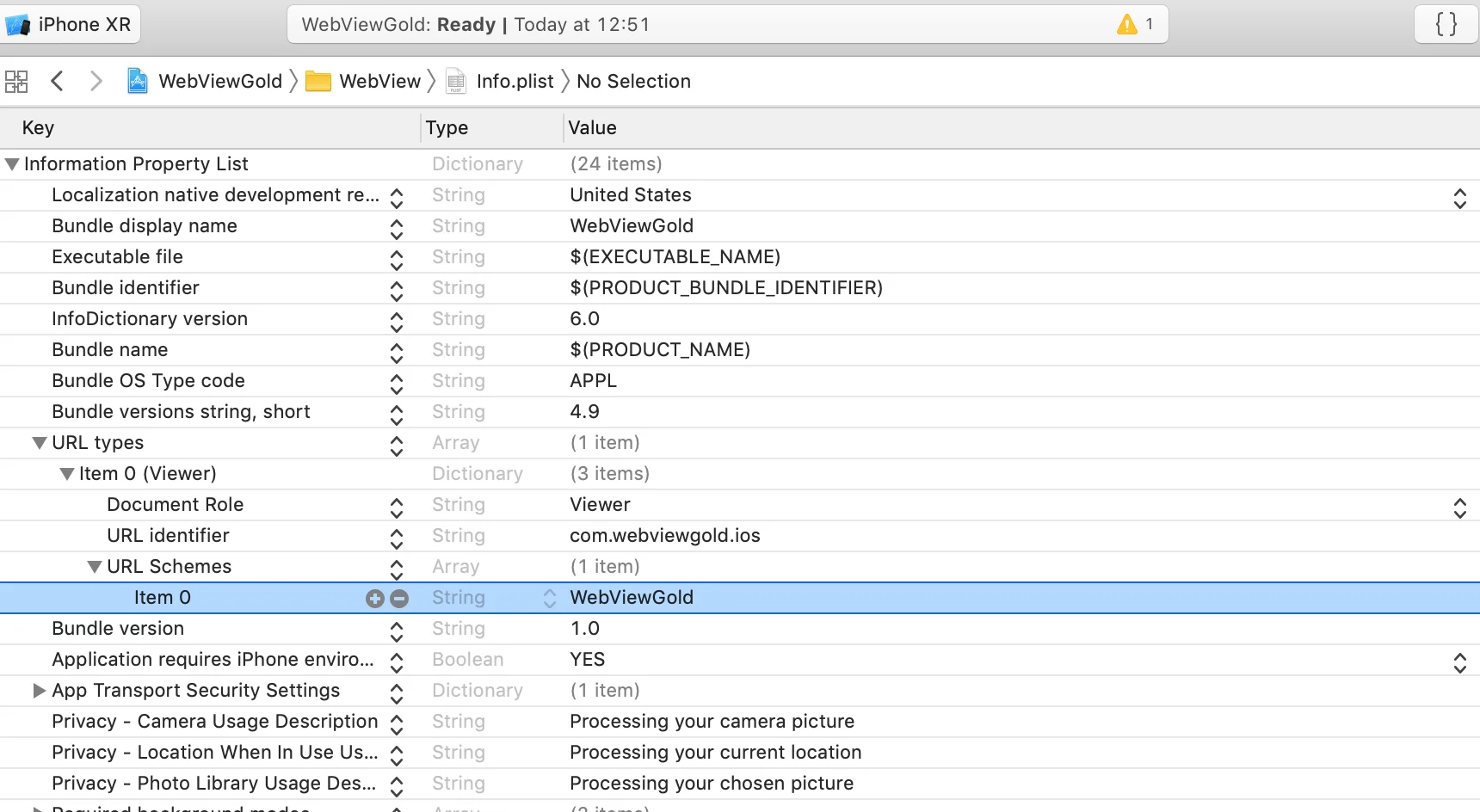
Done! :) The example below would open google.com in the WebView app:
WebViewGold://url?link=https://www.google.com
SDK-style implementation notes
Treat this feature as a native capability exposed to your web layer: keep your production website or PWA as the source of truth, then use the documented WebViewGold configuration flags, URL commands, and JavaScript bridge calls to opt in to native iOS behavior only where it adds value. This approach keeps your codebase maintainable because the same web application can serve browsers, WebViewGold for iOS, and the other WebViewGold platforms with minimal conditional logic.
For reliable results, prefer HTTPS endpoints, stable route names, explicit success/error states in your UI, and small JavaScript helper functions that wrap native calls. For example, a web app built with jQuery Mobile, Lovable, Base44, Bolt, WordPress, Bubble, a custom React/Vue/Angular stack, or static HTML can expose a single button or event handler that triggers the native WebViewGold API while still showing a graceful browser fallback.
- Recommended integration pattern: detect the app context, call the WebViewGold API, then update your web UI after the native callback or route change.
- Testing checklist: validate the feature on a real device or packaged build, verify permissions and store review text, and confirm that browser-only users still receive a useful fallback.
- SEO benefit: keep feature pages, route titles, and structured content indexable on your website while WebViewGold delivers the native app shell for iOS users.